
August 8, 2026: There is a familiar rhythm to the Hindi war film. Soldiers stare into the distance, patriotic lines arrive on cue, enemies are painted in broad strokes, and the final battle is designed to leave the audience cheering. After years of seeing the same formula, even a story based on a real conflict can feel strangely familiar.
Operation Safed Sagar begins with the promise of doing something different.
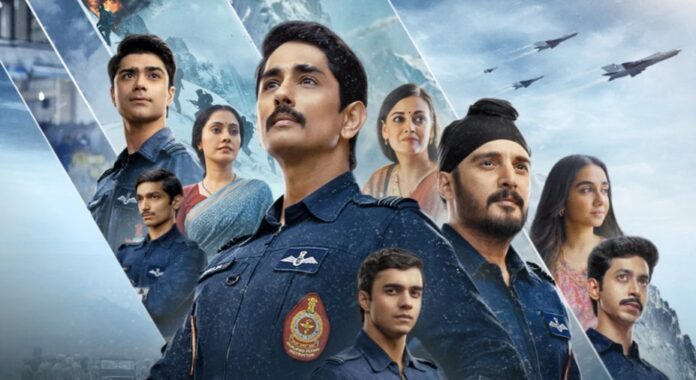
Set against the Indian Air Force’s role in the 1999 Kargil War, the six episode Netflix series focuses on the Golden Arrows squadron and the young pilots who found themselves at the centre of a dangerous high altitude conflict. The series also draws from real people and events, with Air Force veteran Group Captain Tarun Kumar Singha serving as a lead consultant. His connection to the story gives the show an added sense of purpose, especially because Squadron Leader Ajay Ahuja, played by Siddharth, was his course mate at the National Defence Academy.
What makes the early episodes work is the decision to spend time with the people before turning them into heroes. Siddharth plays Ahuja with a quiet confidence that immediately separates him from the usual loud war film protagonist. He arrives at the base on an old scooter, prompting Wing Commander Tony, played by Jimmy Shergill, to joke about the age of the vehicle compared with the MiG fighters. It is a small moment, but it tells us exactly what the series is trying to do.
These are officers, but they are also people. The pilots train, tease each other, eat together and find ways to deal with the pressure around them. One of the nicest touches is the tradition of juniors turning up at a senior officer’s house for dinner and eventually being put to work in the kitchen. Moments like these give the series a lived in quality. The war becomes more meaningful because we have seen the ordinary lives that exist around it.
The flying sequences also benefit from this approach. The early episodes have the excitement of a sports drama, with pilots practising formation flying, photographing enemy positions and trying to avoid surface to air missiles. The influence of Top Gun is easy to spot, but the show generally uses it as a framework rather than simply copying its swagger.
The supporting cast adds further texture. Abhay Verma, Mihir Ahuja, Taarukh Raina and Arnav Bhasin play the younger pilots, with Baldy emerging as the most interesting of the group. His doubts and personal relationship with Madhavi, played by Prajakta Koli, bring another side to the story.
Sadly, this is where the writing becomes less confident. The relationship between Baldy and Madhavi has room for emotional depth, but it often slips into familiar romantic drama territory. Koli is also given very little opportunity to move beyond the kind of screen persona audiences already associate with her. The result is a track that feels disconnected from the stronger material surrounding it.
The Operation Safed Sagar series is more interesting when it looks across the border. Pakistan’s political situation is given more attention than is usual in Hindi war dramas. Nawaz Sharif, played by Vinay Pathak, is shown as a leader caught between political ambition, family influence and the powerful military establishment. Manu Rishi Chadha’s Pervez Musharraf is presented as a figure with his own calculations and authority.
For a while, this gives the story welcome complexity. Then the war begins, and much of that complexity starts disappearing. The Pakistani military is gradually pushed into familiar territory. Cruelty becomes more pronounced, while moments of humanity appear briefly before being overridden by harsher actions. The writing seems caught between wanting to present a complicated enemy and wanting to deliver the kind of emotional anger expected from a conventional war drama.
That tension becomes increasingly visible in the final episodes. Operation Safed Sagar spends much of its running time trying to avoid the standard language of chest thumping patriotism. But when the climax arrives, the familiar machinery returns. There are emotional speeches, determined looks between pilots and an apparently impossible mission that suddenly finds its solution.
The transition feels abrupt. The show also leans heavily on the deaths of Indian soldiers to generate emotional impact. The loss of life is central to any story about Kargil, but the series sometimes uses tragedy more as an emotional weapon than as an opportunity to explore what war actually costs.
Operation Safed Sagar Review: Heroes Without the Hype
This is particularly striking because the real story behind Operation Safed Sagar is already powerful enough.
The Indian Air Force’s role in Kargil was a crucial part of the conflict, and the involvement of veterans such as Tarun Kumar Singha and B.S. Dhanoa gives the series a strong foundation. Dhanoa has spoken about his long standing wish to see the Air Force’s contribution to Kargil brought to a wider audience. The series clearly carries that intention.
Its strongest achievement is therefore not the final battle. It is the human detail around the battle. The conversations inside the base, the pressure on young pilots, the families waiting at home and the knowledge that every training mission could become real are more effective than the loudest patriotic dialogue.
The show also raises an uncomfortable question through its treatment of the two armies. Near the end, Colonel Sartaj echoes an idea familiar from Lakshya, that there should be a difference between the Indian and Pakistani armies, particularly in how they treat the dead.
It is a powerful idea. Yet Operation Safed Sagar does not always trust that idea enough to let it stand on its own. At several points, the series chooses emotional certainty over moral complexity. That keeps it from becoming the thoughtful war drama it occasionally threatens to be.
Still, there is plenty here to appreciate. Siddharth brings restraint to Ahuja, Jimmy Shergill gives the squadron an easy authority, and the younger cast adds energy to the training sequences. The involvement of Air Force veterans also gives the story a grounding that many fictional war dramas struggle to find.
Operation Safed Sagar works best when it remembers that patriotism can exist quietly. A pilot preparing for a mission. A family waiting for a phone call. Friends sharing dinner after a difficult day. A young officer questioning whether he is ready. These details say more about service and sacrifice than a room full of shouted slogans ever could.
The series takes a promising route away from the tired language of the Bollywood war film, but eventually finds itself returning to some of the same roads. It flies high in its quieter moments. It simply does not always know when to stop shouting.
Verdict: 3.5/5
Operation Safed Sagar is worth watching for its human moments, strong performances and attempt to explore the Kargil story through the Indian Air Force. Its biggest weakness is that the nuanced drama of its early episodes gradually gives way to more familiar patriotic storytelling. A solid war series that comes close to being something more memorable.