
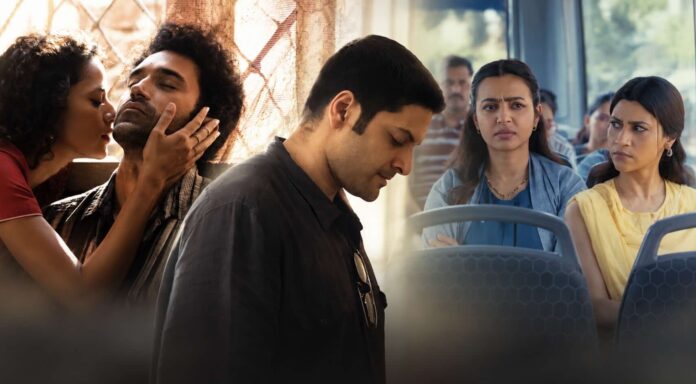
September 18, 2026: Lust Stories 3 arrives with a familiar promise; four filmmakers, four stories and desire somewhere at the centre of each one. But by the third instalment, the bigger question is no longer whether the anthology can make sex and relationships feel provocative. It is whether it can still find something fresh to say about them.
This time, the answer is uneven. The Netflix anthology brings together Vikramaditya Motwane, Kiran Rao, Shakun Batra and Vishal Bhardwaj, with each filmmaker approaching intimacy from a different angle. The stories move between comedy, relationship drama and period romance, but the strongest moments come when the films stop trying to make lust the headline and instead examine what desire reveals about the people experiencing it.
Motwane gets the anthology off to a playful start with a story about two women stuck in marriages that have lost their spark. Shonali, played by Konkona Sen Sharma, and Padma, played by Radhika Apte, discover the idea of partner-swapping through a Korean drama and decide to experiment during a holiday.
It sounds like a setup for something considerably more scandalous than what follows. Instead, Motwane turns it into an awkward comedy of adult desperation. The humour comes less from the sexual premise and more from the characters’ increasingly elaborate attempts to convince themselves that they are in control.
Konkona is particularly good at playing Shonali’s barely contained unpredictability, while Radhika brings an amusingly deadpan quality to Padma. Vijay Varma and Abhishek Banerjee add to the comic chemistry. The segment does not completely land, but it has enough eccentricity to make its relatively tame treatment of the subject work.
Kiran Rao takes the anthology into stranger territory with Lisa, a nail salon employee played by Sana Thampi, and Karan, a pizza delivery worker played by Gurfateh Pirzada. Their relationship develops around Karan’s need for a convenient cover, although Lisa’s own motivations gradually complicate the arrangement.
There is an appealing offbeat quality to this segment, particularly in the way Rao builds its characters and introduces a feline presence into the story. Pirzada fits comfortably into the role, while Thampi gives Lisa a quiet unpredictability. The problem is that the story explains too much. Once its central surprise becomes apparent, there is little left for the audience to discover.
Shakun Batra’s contribution is more familiar territory: a marriage that has reached the point where conversation itself has become exhausting. Varun, played by Ali Fazal, and Sailee, played by Radhikka Madan, are caught between wanting to save their relationship and recognising that the relationship may already have changed beyond repair.
The segment attempts to make communication — and the absence of it — its central idea. Unfortunately, the writing occasionally makes the characters sound more like people delivering carefully constructed lines than a couple actually arguing with each other.
Still, Ali Fazal finds something interesting beneath Varun’s frustration. His performance becomes increasingly compelling as the character’s inability to either hold on to the marriage or completely walk away from it comes into focus. Radhikka Madan holds her own, although the segment never quite reaches the emotional depth it appears to be aiming for.
Lust Stories: The anthology saves its richest material for the final story.
Vishal Bhardwaj takes Lust Stories 3 back to 1987 Hyderabad, creating a world steeped in Urdu literature, old-world manners and the quiet restrictions placed around female desire. Aditi Rao Hydari plays Saira, a college lecturer whose imagination has been awakened by literature but whose marriage leaves little room for the kind of intimacy she longs for.
Siddharth plays her husband Badru, a doctor whose response to his wife’s dissatisfaction is almost comically clinical. The contrast between what Saira wants and what her husband thinks she needs gives the story its central tension.
This is where Lust Stories 3 becomes more interesting than its title suggests. Bhardwaj isn’t simply examining sexual frustration. He is looking at who gets to define desire within a marriage — and how easily a woman’s longing can be treated as something excessive, inconvenient or even embarrassing.
Aditi Rao Hydari gives the film its most memorable performance. Saira’s yearning is visible in her expressions long before she openly articulates it, and the actor manages to make the character sensual without reducing her to that quality. Siddharth provides a restrained counterpoint, allowing the marriage to feel complicated rather than simply divided into a victim and a villain.
The period setting also gives Bhardwaj room to indulge his visual instincts. The colourful production design, Hyderabad setting and literary references create an atmosphere that feels distinct from the contemporary stories preceding it.
Not everything works. The final stretch becomes more explicit about its themes than necessary, with dialogue that explains emotions the performances had already communicated. The film occasionally slips into a polished, poetic mode when a little restraint might have made the conclusion more powerful.
That inconsistency runs through Lust Stories 3 as a whole. Some segments are playful but lightweight, others attempt emotional complexity without fully earning it. The anthology’s central subject may be desire, but its most compelling theme is actually the tension between what people want and what their relationships allow them to have.
There is also something increasingly limiting about the anthology’s familiar framework. After three films, the format has become recognisable enough that provocation alone no longer feels particularly daring. The stories work better when they explore loneliness, marriage, social expectations and emotional incompatibility rather than simply treating lust as a source of shock.
Lust Stories 3 is therefore less a provocative anthology than a collection of relationship stories using desire as their entry point. Two or three segments may leave you wanting more, but Bhardwaj’s period drama gives the film its strongest emotional and cinematic identity.
The result is an uneven watch, but not an empty one. The best moments come when Lust Stories 3 remembers that desire is rarely just about sex. Sometimes it is about being seen, understood and wanted — and the consequences when those needs collide with marriage, convention and the stories people tell themselves.