
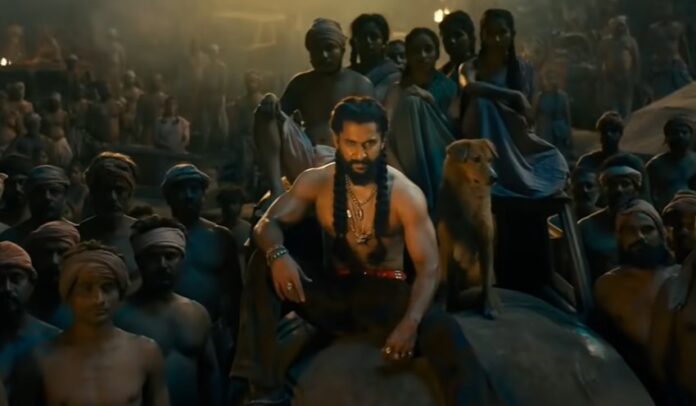
September 25, 2026: There is a certain kind of film that wants to be taken seriously simply because it is grim, violent and visually aggressive. The Paradise falls into that trap. It has the ingredients of a provocative revenge drama—a brutal feudal system, a community pushed to the margins, a protagonist carrying years of anger and a villain who seems to control an entire world, but the film rarely turns those ingredients into a convincing story. What begins with the promise of a powerful tale about oppression gradually becomes an exhausting succession of violence, stylised imagery and narrative shortcuts.
Starring Nani, Kayadu Lohar, Raghav Juyal, Mohan Babu, Sampoornesh Babu, Sonali Kulkarni and others, the film is set in the 1980s and revolves around the Savaris, a fictional denotified tribe living under the control of Shikanja Malik (Mohan Babu). He runs Paradise like a personal fiefdom, forcing the community into illicit liquor production while keeping them outside the systems that are supposed to protect citizens. They have no proper identity documents, are denied basic assistance and are treated by the police as criminals by default.
The film establishes this oppression almost immediately, but it rarely explains how the system actually functions. Shikanja Malik is presented as someone with enormous influence over the police, politicians and the local population, yet the screenplay does little to show how he acquired or maintains that power. His authority is something the audience is simply expected to accept. The same problem runs through much of the film: important aspects of the world are announced rather than developed.
At the centre of this world is Jadal (Nani), whose childhood is defined by humiliation. After stealing from Shikanja Malik’s family and attempting to retaliate against his son Chota Malik (Raghav Juyal), Jadal is brutally punished and permanently marked with an insult on his arms. The humiliation becomes part of his identity, and his anger eventually turns towards his own mother, Sammakka, who has spent years trying to obtain identity cards for the Savari community. After Jadal is imprisoned on murder charges, he returns to Paradise 14 years later carrying the accumulated rage of his childhood.
This should have been the foundation for a compelling revenge story. Instead, the film struggles to decide what kind of film it wants to be. It talks about collective oppression but follows the familiar trajectory of an individual revenge drama. It wants to make a political statement but repeatedly interrupts itself for elaborate action sequences. It introduces ideas about discrimination and identity but seldom gives its characters enough depth for those ideas to resonate.
The relationship between Jadal and Subbu (Kayadu Lohar) is one example of this problem. Rather than organically becoming part of the larger narrative, their track often feels like an excuse to introduce more visually attractive locations and sequences. The scenes set around Yakut Mahal theatre and Liberty Cafe have atmosphere and production value, but their cinematic appeal does not translate into narrative importance. They look designed to be remembered as images rather than scenes that move the story forward.
The chapter structure creates a similar impression. Writer-director Srikanth Odela divides the film into sections with elaborate titles, suggesting a more ambitious narrative design. But the chapters do not substantially alter the way the story is told. The film remains largely linear, and the divisions often feel decorative rather than structural. The device creates the expectation of a carefully constructed narrative without actually giving the screenplay the complexity that such a structure promises.
The film’s biggest missed opportunity is its treatment of the Savaris themselves. A story about a marginalised community needs more than scenes showing that its members are being abused. We need to understand their relationships, their routines, their fears, their aspirations and the ways they have adapted to the system imposed on them. Paradise spends considerable time showing their suffering but much less time showing who they are beyond that suffering.
That becomes particularly uncomfortable because the film is exceptionally interested in violence. Torture, humiliation, bloodshed and physical degradation are repeatedly presented with considerable visual emphasis. The camera appears fascinated by the brutality inflicted on the community, while the screenplay does not always provide the emotional context necessary to make those moments meaningful. The result is that suffering frequently becomes spectacle.
The crow metaphor is one of the The Paradise movie’s more interesting ideas. Paradise draws a parallel between the Savaris and crows, suggesting that history has traditionally celebrated birds such as parrots and doves while ignoring the crow despite all of them belonging to the same world. It is a potentially effective way of talking about how certain communities are erased from the stories that society chooses to preserve. Unfortunately, the film does not develop the metaphor with enough consistency. Instead of becoming a recurring symbol of memory, survival or exclusion, the crow imagery often gets folded into the film’s visual language around violence.
The Paradise Review: A Visually Fierce Film That Struggles to Give Its Anger Meaning
The screenplay also becomes increasingly difficult to take seriously because of inconsistencies in basic continuity. Characters survive situations in which their fate appears to have been clearly established, while confrontations sometimes unfold without convincing explanations for why a character behaves one way rather than another. There is a moment when Jadal confronts Shikanja Malik and physically humiliates him, yet the film does not adequately establish why Malik, given the power he supposedly possesses, allows the situation to continue. These aren’t minor technicalities when the entire story depends on a carefully established hierarchy of power.
Even character details that appear deliberately meaningful are not always followed through. Jadal’s hairstyle, for instance, is connected to his childhood relationship with his mother, who insists on styling his hair in a particular way. Once that relationship deteriorates, however, the film does not convincingly explain why the same visual detail remains part of his adult identity. On its own, this would be insignificant. But when a film repeatedly assigns symbolic meaning to appearances and objects, such inconsistencies become more conspicuous.
The world-building is similarly uneven. The Paradise is supposed to feel like a functioning community, yet the settlement frequently resembles a constructed film set rather than a place where generations of people have lived. Shikanja Malik’s residence has a similar artificial quality. The persistent use of darkness and rain is clearly intended to create a brooding atmosphere, but after a point it starts feeling like the film is using gloom as a substitute for mood and texture.
The political references are another distraction. The appearance of a character resembling former Telangana Chief Minister K Chandrasekhar Rao seems designed to evoke memories of the Telangana movement and its political history. Yet the reference does not develop into anything substantial enough to justify its presence. Instead of expanding the film’s political context, it feels like another gesture towards the audience.
There is something commendable about a mainstream film attempting to address subjects that are uncomfortable and rarely explored. Paradise is clearly reaching for something larger than a straightforward revenge story. But when the subject involves an oppressed community, the film has to be particularly careful about the difference between depicting brutality and turning brutality into entertainment. Paradise does not always make that distinction successfully.
The performances are unevenly served by the screenplay. Tanikella Bharani has little opportunity to make an impression, while Sampoornesh Babu is given a role that feels underwritten. Raghav Juyal’s Chota Malik never develops into the kind of antagonist the story needs. Sonali Kulkarni has more material to work with, while Mohan Babu gets the most substantial villainous presence among the supporting actors. His return to a role of this nature has its pleasures, particularly because he brings an unmistakable theatricality to Shikanja Malik.
Nani commits fully to Jadal’s physical transformation and simmering anger, but the performance can only go as far as the writing allows. The character is burdened with trauma, rage and revenge, yet the screenplay doesn’t consistently give him enough emotional texture between the action sequences. As a result, his journey often feels defined by what happens to him rather than by the choices he makes.
Anirudh’s music works overtime to make scenes feel larger and more intense. The score repeatedly pushes the emotional volume upwards, but there is a limit to what music can accomplish when the underlying scene has not been properly constructed. A louder score cannot supply missing motivation or repair a weak dramatic beat.
What ultimately makes Paradise frustrating is not that it attempts something ambitious and fails. Ambition is rarely the problem. The film has plenty of ideas: social exclusion, inherited humiliation, institutional discrimination, historical erasure and revenge. It also has moments of striking imagery and several sequences that demonstrate Srikanth Odela’s ability to create a strong visual atmosphere.
The problem is that these elements rarely come together into a coherent whole. The film keeps reaching for another shocking image, another violent confrontation or another dramatic flourish before properly developing the idea that came before it. Its anger is evident, but the screenplay does not always know how to translate that anger into character or story.
Paradise therefore ends up caught between two identities. As a revenge film, it takes too long to get to the emotional payoff and repeatedly interrupts its central conflict. As a story about oppression, it spends too little time understanding the people at its centre. And as a political drama, it often settles for imagery and references instead of examining the structures it introduces.
There are moments here that suggest a far more compelling film was possible. The idea of a community deliberately kept outside official recognition could have produced a powerful story about identity and belonging. Jadal’s relationship with his mother could have given the revenge narrative an intimate emotional core. The crow metaphor could have become an evocative exploration of forgotten histories. Instead, the film keeps choosing escalation over exploration.
By the end, the violence has become so frequent that it loses much of its intended impact. What should feel shocking starts to feel routine. What should feel tragic begins to feel choreographed. And what should have been an emotionally charged story about people fighting against a system becomes increasingly preoccupied with the spectacle of their suffering.
Paradise clearly wants to be more than a conventional revenge drama. Its intentions are visible in almost every frame. But good intentions and striking imagery cannot compensate for a screenplay that does not adequately build its world, characters or political ideas. The film mistakes intensity for depth too often, leaving behind a work that is visually forceful but dramatically thin.
For a film that wants to speak about people who have been denied a place in history, Paradise spends surprisingly little time allowing us to know them. That is ultimately its biggest weakness.