
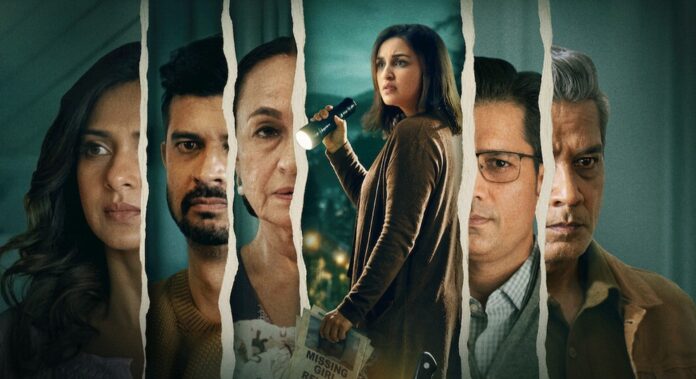
October 5, 2026: Shaque: Trust No One review : If a thriller tells you to trust no one, the obvious challenge is to figure out whom you can trust. With Shaque: Trust No One, the answer turns out to be surprisingly simple: trust your instincts when the screenplay starts making suspiciously convenient choices.
The seven-episode Netflix series opens in a Shimla maternity ward, where Anvita Dutt (Parineeti Chopra) has just become a mother. Her newborn daughter Apeksha is surrounded by family, friends and assorted well-wishers, all of whom wear expressions suggesting they have either committed a crime or know exactly who did. The camera lingers on nervous glances, guilty faces and ominous silences with such enthusiasm that the background score might as well lean into the frame and whisper, “Suspect everyone.”
Then the baby disappears. Eight years later, Anvita is still searching. She has had another child, but the missing daughter remains the emotional centre of her life. Every year, on the missing girl’s birthday, the kidnapper sends photographs as proof that she is alive. Anvita eventually announces a Rs 15 lakh reward for information, but much like other famous promises involving Rs 15 lakh, the money remains remarkably theoretical.
The setup is actually strong. A mother searching for a child who may still be alive, a marriage full of cracks, a family packed with secrets, a policeman who refuses to abandon the case and a neighbouring family with a daughter who happens to be the exact age Anvita’s missing child would be today , there is enough material here for a properly addictive thriller.
The show also understands the basic grammar of the genre. Everyone looks suspicious. Everyone has something to hide. Every new revelation points towards another possible culprit. The trouble is that Shaque keeps confusing suspicion with mystery.
Officer Khurana, played by Anup Soni with an easygoing authority, becomes the most dependable presence in the series almost by accident. He has spent eight years investigating Anvita’s case and appears to have developed an impressive ability to make every other crime in Shimla somehow lead back to the same missing child. He also reads Tarot cards and insists that the cards do not lie. At certain points, you may find yourself wondering whether the cards could simply solve the entire case and let everyone go home.
Anvita’s psychological state gives the story another layer. Her trauma, coupled with spiked drinks, leaves her hallucinating and seeing her missing daughter in other eight-year-old girls. That creates a potentially fascinating unreliable-narrator dynamic because the central question is no longer simply who stole the baby, but whether Anvita can trust what she is seeing.
Shaque Review: Suspicion Runs High, Logic Runs Dry
The arrival of Sakshi (Jennifer Winget) and Gaurav (Dhruv Chaudhary), whose daughter is the same age Apeksha would be now, should turn that uncertainty into something deliciously uncomfortable. Is this finally Anvita’s daughter, or is grief once again rewriting reality for her?
The Shaque: Trust No One Show knows how to manufacture that question. Unfortunately, it is less interested in earning the answers. Advit’s affair with Anvita’s best friend Shreya (Harleen Sethi), Shreya’s marriage to doctor Bhaskar (Sumeet Vyas), Bhaskar’s own secrets, Anvita’s difficult relationship with her mother-in-law Madhu (Soni Razdan), black magic, a mysterious baba and even the possibility of an illegal child-trafficking network are all thrown into the mix.
There is plenty happening. Perhaps too much. The series seems determined to give every character a suspicious hobby, secret relationship or morally questionable decision. Yet many of these apparent clues eventually amount to little more than elaborate distractions. You can almost see the writers placing a giant red arrow over certain characters saying, “Look here, but not too closely.”
That becomes the central weakness of Shaque. The mystery is not particularly difficult to follow; the problem is that the screenplay repeatedly makes the characters behave in ways designed solely to preserve the mystery. People confess things at remarkably convenient moments. Information that should have emerged much earlier suddenly appears when the plot needs a push. Evidence sits in plain sight until someone finally remembers that it exists. Crucial CCTV footage takes an unnecessarily scenic route before yielding its significance.
Khurana, otherwise presented as a competent investigator, occasionally behaves as though the investigation has been written by someone who needs him to discover things at precisely the right episode. His decision-making becomes particularly questionable when he separates himself from the people assisting him and heads into dangerous situations alone.
Then there is the DNA evidence, the circumstances under which it is obtained and the ease with which it becomes useful to the investigation. The show expects viewers to accept these shortcuts because there is another twist waiting around the corner. But a thriller cannot keep asking the audience to suspend disbelief every time it runs out of plausible ways to move the story forward.
That is where Shaque‘s promise of “trust no one” takes on an unintentionally amusing meaning. You start out distrusting the characters. By the middle, you are distrusting the investigation. By the end, you are wondering whether the screenplay itself can be trusted to play fair.
There is also a strange sense of déjà vu hanging over the whole enterprise. The bitter mother-in-law, the unfaithful husband, the conveniently dark secret, the sudden illness and the traumatised woman whose version of reality cannot be taken at face value are all familiar thriller furniture.
Parineeti Chopra has played variations of this emotionally battered, psychologically cornered woman before, most notably in The Girl on the Train. Anvita gives her another opportunity to inhabit that space, but the character never quite escapes the machinery of the plot. Chopra commits to the emotional turmoil, yet the writing keeps pulling her back into familiar territory.
The direction is similarly functional rather than distinctive. Rensil D’Silva, who created, wrote and directed the series, has the ingredients for a tense psychological mystery but rarely gives the material a visual identity of its own. The ominous looks, dramatic pauses and persistent suggestion that everyone is hiding something sometimes make the show feel less like a tightly wound thriller and more like a glossy television melodrama.
And that is a shame because the basic premise deserved better. A mother who has spent eight years searching for a stolen child is inherently compelling. Add an unreliable perspective, a potentially connected family, a detective who has become personally invested in the case and a trail of deliberately planted suspects, and you have the foundation for a thriller that could genuinely mess with the audience’s head.
Shaque instead keeps pointing at the smoke while occasionally forgetting to build the fire. It remains watchable because the central mystery does have enough hooks to keep you moving through its seven episodes. There are moments when the show briefly catches the rhythm of the thriller it could have been. But each time it gets close, another convenient revelation or familiar cliché knocks the tension sideways.
Shaque: Trust No One wants you to question everybody. Fair enough. But when the biggest questions are raised by the screenplay’s own shortcuts, the title starts sounding less like a warning to the audience and more like advice from the reviewer