
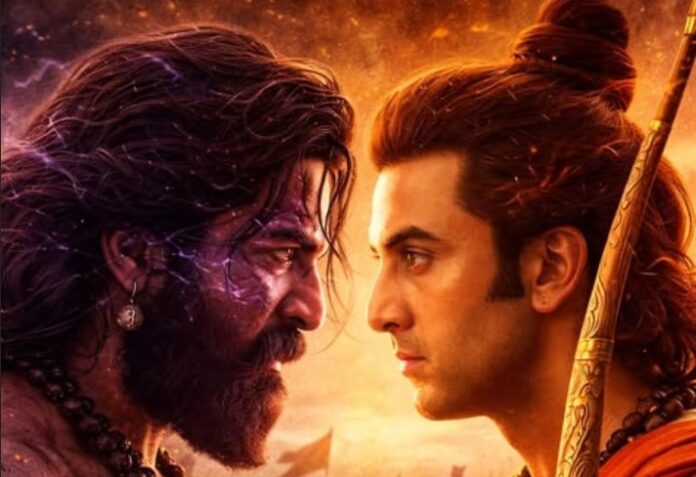
Bollywood, November 5, 2026: Adapting the Ramayana for the big screen is no ordinary filmmaking challenge. It is an epic that generations have grown up listening to, watching and understanding in their own ways. With Nitesh Tiwari at the helm, Ranbir Kapoor as Rama and Yash as Ravana, expectations were naturally sky-high. The biggest question was whether the makers could offer something fresh while remaining faithful to the emotional and cultural depth of the original. Ramayana Part One largely succeeds, delivering a grand cinematic experience that balances mythology, spectacle and human emotions.
The film opens with Ravana’s growing dominance, as Dashanana (Yash) challenges the authority of the gods, defeats Indra (Kunal Kapoor) and establishes his supremacy over Lanka. His ambition to rule beyond mortal boundaries sets the larger conflict in motion. Meanwhile, Lord Vishnu takes human form as Rama (Ranbir Kapoor), the firstborn of King Dasharatha. What follows is Rama’s journey through royal responsibilities, his marriage to Sita (Sai Pallavi), exile alongside Lakshmana (Ravie), and the circumstances that eventually bring him face-to-face with Ravana. The kidnapping of Sita becomes the turning point, setting the stage for the legendary battle between good and evil.
A familiar story with some interesting new layers
The biggest achievement of Ramayana Part One is that it manages to hold your attention despite telling a story whose broad strokes are already familiar to almost every Indian household. Nitesh Tiwari and Shridhar Raghavan approach the material with an emphasis on expanding the characters rather than simply rushing through iconic events. The film spends considerable time exploring Ravana’s rise, his ambitions and the world that existed before he became the formidable ruler we know. This gives the antagonist a larger presence and adds context to his eventual clash with Rama.
There are several interesting additions that make the narrative engaging. Rama’s relationship with Kaikeyi receives emotional attention, while his encounter with Parashurama and the circumstances surrounding his divine weapons add interesting dimensions to his journey. The growing bond between Rama and Sita during their exile is another highlight. These moments give the characters room to breathe and prevent the film from becoming just a series of familiar mythological episodes.
The screenplay deserves credit for finding dramatic value in a story whose destination is never really a mystery. However, the expanded storytelling occasionally comes at the cost of pace. Certain portions, particularly around the middle of the first half and some stretches in the second half, could have been tighter. A little more restraint in these sections would have made the overall experience even more absorbing.
Nitesh Tiwari delivers on the scale and ambition
Nitesh Tiwari approaches the material with considerable confidence. The director understands that an epic of this magnitude cannot survive on visual grandeur alone. It needs emotional grounding, compelling characterisation and a strong narrative spine. For the most part, he gets that balance right.
The production design and world-building deserve special appreciation. Lanka, the celestial realms and the larger mythological landscape have been imagined on an impressive scale. Namit Malhotra’s ambition to bring this Indian epic to a global cinematic audience is evident in the film’s technical execution. The major action sequences are designed to create a genuine sense of scale, and several visual moments are genuinely breathtaking.
The background score by Hans Zimmer and A.R. Rahman adds tremendous weight to the proceedings. Their musical contribution elevates the emotional and dramatic moments, particularly when the narrative moves towards its larger confrontations. The sound design further enhances the theatrical experience.
That said, the visual effects are not equally convincing throughout. While several sequences are spectacular, a few shots involving enormous creatures and digitally created environments look unfinished or overly animated. For a film that places so much emphasis on visual immersion, these inconsistencies are noticeable. The technical ambition is admirable, but a more consistent finish would have made the spectacle considerably stronger.
Ranbir Kapoor and Yash are the film’s Ramayana’s biggest strengths
Ranbir Kapoor brings an understated dignity to Rama. Rather than playing the character with exaggerated expressions or unnecessary theatricality, he chooses restraint, warmth and emotional sincerity. His portrayal has a calmness that suits the character, and he is particularly effective in the more vulnerable moments.
The sequence involving Kaikeyi’s announcement of Rama’s exile is among his strongest portions. His interactions with Dasharatha and the emotional acceptance of his circumstances reveal an actor who understands that Rama’s strength lies as much in his composure as in his courage. Ranbir gives the character an accessible human quality without losing the reverence associated with the role.
Yash, meanwhile, makes a strong impression as Ravana. The film gives considerable narrative space to the character, and Yash uses that opportunity effectively. His screen presence, intensity and commanding personality make Ravana a compelling force throughout. There is an interesting combination of ambition, arrogance and menace in his portrayal. He does not merely function as the villain waiting for the hero; he has his own journey, motivations and larger ambitions. In many ways, Ravana becomes the narrative’s driving force in this first instalment.
Sai Pallavi is a wonderful choice for Sita. She brings grace, innocence and inner strength to the character without making her seem one-dimensional. Her chemistry with Ranbir feels natural, and their moments together during exile provide some of the film’s most heartfelt passages.
Ravie as Lakshmana is another pleasant surprise. He brings loyalty and emotional intensity to the role, while his occasional humour provides welcome relief. There are moments in the second half where his performance particularly stands out.
The supporting cast adds considerable value. Rakul Preet Singh makes an impression as Surpanakha, bringing the required sharpness and menace to the character. Vivek Oberoi is effective as Vidyutjihva, while Arun Govil lends dignity to King Dasharatha. Lara Dutta makes her presence felt as Kaikeyi, and Adinath Kothare is convincing as Bharat. Anupam Kher’s voice performance as Jatayu is especially moving, adding emotional weight to the film’s closing stretch. Saurabh Sachdeva also makes a notable impression as Maricha.
Where the film could have done better
Despite its many strengths, Ramayana Part One is not without shortcomings. The biggest concern is its occasional inconsistency in pacing. The film takes its time establishing characters and expanding the mythology, which is understandable, but some portions feel unnecessarily stretched.
The other concern is the uneven visual effects. When a film sets such an ambitious technical benchmark, even a handful of visibly artificial shots can interrupt the immersion. A more polished finish across all the visual sequences would have helped.
There is also the question of expectations. Those walking into the theatre expecting Rama to dominate the narrative from beginning to end may find the emphasis on Ravana surprising. This instalment is as much about understanding the rise of the antagonist as it is about witnessing Rama’s evolution. That storytelling choice makes sense within the larger structure, but it does mean that Rama’s journey sometimes takes a back seat.
The verdict
Ramayana Part One is an ambitious, emotionally engaging and visually imposing adaptation that understands the responsibility of bringing a timeless Indian epic to contemporary cinema. Its strongest moments come from the writing, the performances and the emotional connections between its central characters. Ranbir Kapoor brings sincerity and restraint to Rama, while Yash gives Ravana the commanding presence the character demands. Nitesh Tiwari deserves credit for attempting to tell a familiar story with additional depth and cinematic ambition.
Yes, the film has pacing issues and some inconsistent visual effects, but these shortcomings do not take away from the larger experience. More importantly, it leaves you invested in the characters and curious about what comes next.
Ramayana Part One may not be flawless, but it is a memorable big-screen experience that treats its source material with ambition and respect. It sets up the larger conflict effectively and leaves the audience waiting for Rama’s journey to unfold further. This is an epic best experienced on the biggest screen possible, preferably with family and friends.