
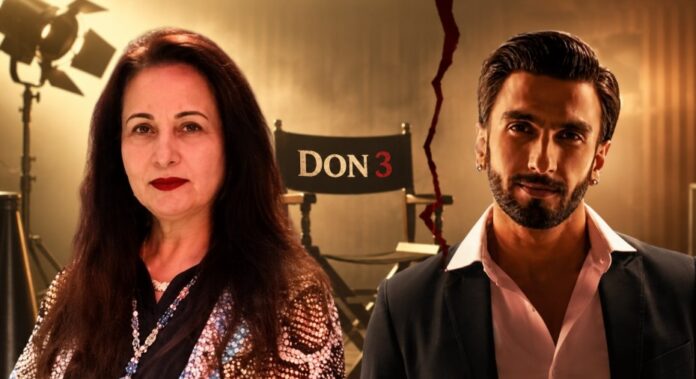
Monday, June 8, 2026: The controversy surrounding Ranveer Singh’s exit from Don 3 is no longer just about an actor walking away from a film. Poonam Dhillon’s new statement, has evolved it into a larger conversation about accountability, creative freedom, and the authority of industry bodies in Bollywood.
The latest twist came when Cine & TV Artists Association (CINTAA) president Poonam Dhillon publicly questioned the non-cooperation directive issued against Ranveer Singh by the Federation of Western India Cine Employees (FWICE). Her remarks have shifted attention away from the financial dispute between the actor and producers and toward a more fundamental question: who gets to decide how industry conflicts are resolved?
At the heart of the issue is Ranveer Singh‘s departure from Farhan Akhtar’s much-anticipated Don 3. Reports suggest the actor returned his signing amount and even offered compensation for losses incurred during the film’s development. While the exact figures remain disputed, sources indicate that his offer fell far short of what the producers believed they were owed.
Poonam Dhillon Defends Ranveer’s Exit from Don 3
For Poonam Dhillon, however, the more significant point is that an attempt at resolution was made. In an industry where project exits are not uncommon, she argued that many actors neither return advances nor offer compensation when they leave a production.
Her support introduces a different perspective to a narrative that has largely focused on contractual obligations. Dhillon’s comments suggest that the industry’s response should consider intent and effort rather than relying solely on punitive measures.
The episode also highlights the changing role of actors in modern filmmaking. Unlike previous generations, leading stars today are increasingly involved in script development, project planning, and creative decision-making. Dhillon defended an actor’s right to reconsider a project if concerns emerge over the script or creative direction, arguing that performers ultimately bear the public consequences when a film underperforms.
Yet her comments carried a warning as well. Actors, she noted, must be cautious about committing to projects based on relationships rather than fully evaluating the creative and commercial realities involved.
Perhaps the most revealing aspect of the controversy is the apparent disconnect between industry organizations. Dhillon described FWICE’s action as unexpected and suggested CINTAA was not consulted before the directive was announced. That observation points to a broader institutional challenge within Bollywood, where multiple bodies often represent different stakeholders but lack a unified mechanism for dispute resolution.
The Ranveer Singh-Don 3 dispute may eventually be settled through negotiations or legal channels. However, the larger issue exposed by the episode is unlikely to disappear quickly. As film budgets rise and projects become more complex, the industry is increasingly being forced to balance creative freedom with financial accountability.
In that sense, the controversy is less about one actor exiting one film and more about an industry struggling to define how conflicts should be handled in an era where star power, contractual obligations, and institutional authority frequently collide.