
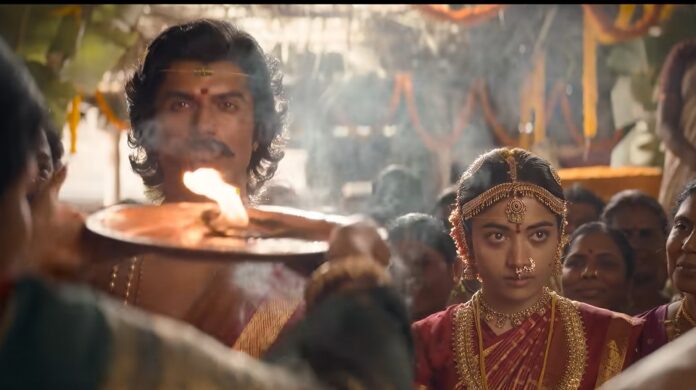
October 18, 2026: Some tragedies are so devastating that a film about them needs more than grand visuals, angry speeches and a hero who takes on an empire. It needs heart. It needs characters who feel real, and a story that makes the audience feel the weight of every life lost. Ranabaali has the ingredients for a powerful historical drama, but despite its ambitious setting and Vijay Deverakonda’s committed performance, the film struggles to turn its serious subject into an engaging cinematic experience.
Directed by Rahul Sankrityan, Ranabaali is set against the backdrop of the Great Madras Famine of 1876 to 1878, one of the darkest periods in colonial India’s history. Vijay plays Singanamala Bobbili Ranabaali, a warrior who rises against British oppression, while Rashmika Mandanna plays Jayamma, his wife. Arnold Vosloo appears as British commissioner Hector, a colonial official whose ruthless pursuit of the Crown’s interests comes at the expense of a starving population.
On paper, this is a story with enormous potential. A devastating famine, a colonial administration that fails its people, food resources being diverted while ordinary Indians struggle to survive, and a man who decides that enough is enough. There is anger, injustice, sacrifice and the possibility of a gripping rebellion. Unfortunately, the film spends so much time showing the cruelty of the British and establishing Ranabaali as a formidable warrior that it loses sight of the human story that should have held everything together.
A strong subject let down by slow storytelling
The Great Madras Famine offers a compelling historical backdrop, and the film deserves credit for attempting to bring this painful chapter of Indian history to the big screen. The suffering caused by drought, crop failures, starvation and the failures of colonial administration is a subject that deserves serious cinematic attention. Ranabaali wants to show how such conditions can push ordinary people towards resistance and turn one man’s anger into a larger fight for justice.
The problem is that the screenplay does not always know how to make this story work as a film. The opening portions do a reasonably good job of establishing the period, the political situation and the conflict between Ranabaali and the British. There is a sense of scale to the proceedings, and Vijay’s introduction gives the film some much needed energy. His presence is commanding, and the character’s determination to stand up to the colonial rulers gives the story a clear direction.
But once the initial excitement settles, the narration begins to drag. Scenes that should build tension often stretch longer than necessary, while the conflict repeatedly returns to familiar territory. The British are shown as cruel, Ranabaali responds with defiance, violence follows, and the cycle starts again. After a point, the repetition becomes difficult to ignore.
A historical drama does not necessarily need constant action to hold attention. It needs characters with believable motivations, meaningful changes in the story and moments that allow the audience to absorb what is happening. Ranabaali has several opportunities to do this, but it too often chooses spectacle over storytelling.
The result is a film that feels considerably longer than it needs to be.
The second half of Ranabaali struggles to find momentum
The first half is the more engaging portion because it introduces the characters, establishes the historical setting and lays the groundwork for the rebellion. There is at least a sense that the story is moving towards something significant.
The second half, however, becomes increasingly repetitive. The confrontations between Ranabaali and the British continue, but the narrative does little to make each encounter feel substantially different from the previous one. The stakes may be high on paper, yet the dramatic impact gradually diminishes because the film keeps returning to the same emotional and narrative beats.
The British sequences are particularly disappointing. Given the importance of the colonial administration to the story, these portions needed sharper writing and a stronger sense of menace. Instead, several scenes feel awkwardly executed, and the conflict lacks the tension required to make the rebellion truly gripping.
Even the climax, which should bring the story’s anger and emotional weight together, takes too long to reach its destination. Rather than leaving the audience overwhelmed by the journey, the film tests their patience at a point when it should be delivering its strongest payoff.
A tighter screenplay and more decisive editing could have made a substantial difference. At nearly three hours, Ranabaali feels as though it has mistaken length for depth. Cutting around 20 minutes, particularly from the repetitive confrontations and extended sequences, might have helped the film maintain its momentum.
Violence that shocks more than it moves
One of the biggest problems with Ranabaali is the way it portrays suffering. A film set during a famine cannot shy away from the terrible consequences of starvation. The deaths, the desperation and the helplessness of people watching their lives fall apart are central to the story. There is nothing wrong with depicting such realities honestly, and a subject of this magnitude should not be softened merely to make it comfortable for viewers.
But there is a difference between showing suffering and making suffering the primary means of generating an emotional response. Ranabaali repeatedly uses distressing images of starving people and graphic violence to communicate the cruelty of the period. Some of these scenes are genuinely disturbing. The problem is that the film keeps returning to this approach without giving the audience enough time to connect with the people enduring the tragedy.
We see the brutality, but we do not always get to know the victims. We understand that the situation is terrible, but the screenplay does not consistently give their individual stories the space they deserve.
This becomes especially difficult in the second half, where the violence begins to lose its impact through sheer repetition. What initially shocks the viewer eventually becomes exhausting. The same applies to the clashes between Ranabaali and the colonial forces. Their brutality is clear, but repeated graphic confrontations do not automatically make the conflict more powerful.
The film could have achieved far more with quieter moments, ordinary people struggling to find food, families trying to stay together and communities pushed to the edge of survival. Such scenes might have brought audiences closer to the tragedy than another extended display of cruelty.
The sequences involving Jayamma in the second half are also distressing. They add to the film’s bleakness, but their emotional impact is limited by the way the story handles them. For a film built around a human catastrophe, the greatest missed opportunity is that the people suffering often become part of the background to the hero’s journey.
Vijay Deverakonda carries the film
If there is one reason to give Ranabaali a chance, it is Vijay Deverakonda. The actor is clearly invested in the role, and his physical commitment is evident throughout the film. He brings the required intensity to a character who must stand against a powerful colonial administration, and his screen presence gives several scenes the energy they otherwise lack.
His introduction is one of the film’s stronger moments. He commands attention, and there is an immediate sense of the character’s confidence and defiance. Vijay looks comfortable in the physical demands of the role, and when the film gives him a strong moment to work with, he makes the most of it.
This is also why the weaknesses in the writing become so frustrating. Ranabaali could have been a defining role for Vijay if the screenplay had allowed him to explore more than the familiar qualities of a fearless warrior. Anger, courage and a willingness to fight are important, but they are not enough to make a character memorable over a three hour film.
We needed to understand the man behind the rebellion. What does the suffering around him do to him? What doubts does he carry? What does he stand to lose, and how does his understanding of justice change as the conflict intensifies?
The film touches on the ingredients of such a character but rarely explores them with sufficient depth. Vijay does what he can with the material, but his performance cannot compensate for the lack of emotional complexity in the writing.
There is a difference between dominating the screen and carrying an entire story. Vijay manages the former, but the screenplay makes the latter an uphill task.
Rashmika Mandanna brings warmth, but Jayamma needed more
Rashmika Mandanna brings some welcome warmth to an otherwise relentlessly bleak film. Her scenes with Vijay offer a glimpse of the personal life that exists beyond the rebellion, and their relationship provides the story with opportunities for emotional connection.
Jayamma could have been an important counterpoint to Ranabaali’s anger. Through her, the film might have explored what the conflict means to families, what survival looks like away from the battlefield and how women experience the consequences of political violence.
Unfortunately, the character is not given enough agency to fulfil that potential. Too often, her presence serves the larger journey of the male protagonist rather than giving her an independent emotional arc. Rashmika brings sincerity to the role, but the writing leaves her with limited room to make Jayamma a fully developed character. A stronger role for her would have also helped balance the film’s repeated focus on action and confrontation.
The chemistry between the lead pair provides a few welcome moments, but there is not enough of them to give the emotional side of the film the strength it needs.
A period drama that looks the part
On the technical front, Ranabaali has several strengths. The cinematography by Jishnu Bhattacharjee and Nirav Shah gives the film the visual scale expected of a period drama. The landscape, the bleak surroundings and the harshness of the colonial setting are brought to the screen with considerable effort.
There are moments when the visuals effectively communicate the desolation of the famine and the grim conditions in which people are forced to live. The production has clearly aimed for grandeur, and the film often looks impressive.
Yet visual scale can only take a film so far. Impressive frames cannot make up for a story that struggles to sustain interest, particularly when the scenes within those frames do not carry enough emotional weight.
The music and background score by Ajay and Atul are another disappointment. The film needs its music to heighten the tension, deepen the personal moments and give the rebellion a sense of urgency. Instead, the score rarely leaves a lasting impression. In a film that relies so heavily on its central character’s anger and the suffering around him, stronger musical support could have made several sequences more effective.
The editing is an equally important concern. The extended runtime makes the film feel sluggish, especially in the second half. Several confrontations could have been shortened without losing their meaning, while some quieter character moments deserved more attention. The balance between action, emotion and historical context is not quite right.
The audience reaction reflects the film’s biggest problem
The early audience response has been mixed, with criticism of the slow narration and the second half appearing frequently. Some viewers have praised Vijay’s screen presence, his introduction and the moments he shares with Rashmika. Others have pointed to the repetitive British sequences, the weak pacing and a climax that takes too long to make its impact.
Both reactions point towards the same underlying issue. Vijay has the ability to hold attention, but the film around him does not consistently give audiences a compelling reason to remain invested. There is certainly a section of viewers who may enjoy the scale, the historical setting and the spectacle of a warrior taking on the British. Those looking for a conventional period action drama may find moments worth appreciating. But viewers expecting a deeply moving account of famine, survival and resistance may leave disappointed.
Verdict: A missed opportunity
Ranabaali begins with the promise of a powerful historical drama and the potential to give Vijay Deverakonda a memorable role. Its subject is important, its ambition is evident, and the lead actor brings considerable commitment to the screen.
But the film never fully bridges the gap between historical tragedy and cinematic storytelling. The slow narration, repetitive confrontations, excessive violence and underdeveloped characters prevent the story from achieving the emotional impact it deserves. The first half offers some promise, but the second half struggles to build on it, and the drawn out climax does little to rescue the experience.
The greatest disappointment is not that Ranabaali attempts to show the horrors of colonial rule. It is that the film has so much to say about suffering and resistance, yet spends too little time making us understand the people caught in the middle of it.
Vijay Deverakonda gives the film his best, but even his screen presence cannot save a screenplay that keeps circling the same ideas. Ranabaali wants to be a stirring story of courage in the face of oppression. What emerges instead is an exhausting period drama that leaves its strongest possibilities unexplored.
Rating: 1.5/5