
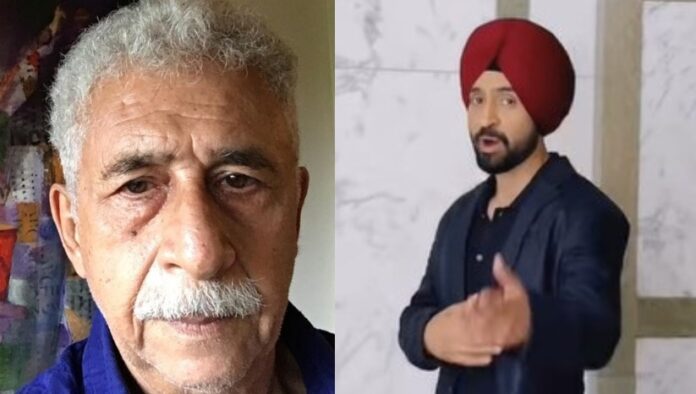
June 30, 2025: While the subcontinent simmers with geopolitical tension, veteran actor Naseeruddin Shah has stepped forward to issue a passionate defence, not of policies, but of people, art, and cultural exchange. In a climate where cinema is increasingly scrutinized through the lens of nationalism, Shah has made it clear: human connection must not fall victim to political noise.
The actor’s bold remarks come in support of Diljit Dosanjh, who is currently under fire over the casting of Pakistani actress Hania Aamir in the Punjabi film Sardaar Ji 3. The film, though drawing enthusiastic crowds in Pakistan, has been banned in India, leading to rising backlash against the actor from various industry groups and political corners.
On Sunday, Diljit Dosanjh took to Instagram Stories to share a video highlighting the film’s overwhelming success in Pakistani theatres. The clip shows Hania Aamir on-screen, accompanied by text praising the film’s multiple sold-out shows on ultra screens.
This seemingly simple gesture has been interpreted by critics as insensitive given the current strained diplomatic environment between India and Pakistan. In light of the recent Pahalgam terror attack and India’s subsequent military response under Operation Sindoor, nationalist voices have intensified their calls for boycotts.
In the wake of the controversy, organizations like the All Indian Cine Workers Association (AICWA) and the Federation of Western India Cine Employees (FWICE) have publicly demanded a ban on Diljit’s future projects. Prominent singer Mika Singh also urged the actor to issue an apology.
Naseeruddin Shah’s Bold Stand for Sardar Ji 3 Diljit Dosanjh
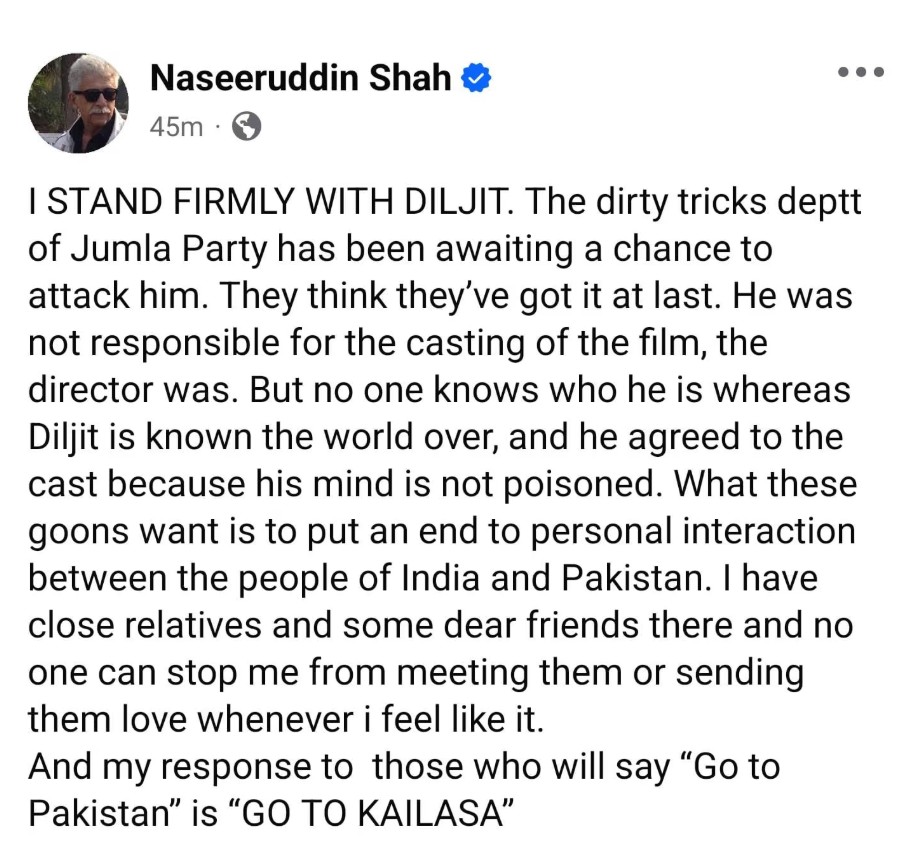
But where many in the industry chose silence or criticism, Naseeruddin Shah opted for clarity and conviction. In a sharply worded Facebook post on Monday, the acclaimed actor dismissed the growing vilification of Diljit as politically motivated.
“I STAND FIRMLY WITH DILJIT,” Shah declared. “The dirty tricks department of the Jumla Party has been awaiting a chance to attack him. They think they’ve got it at last. He was not responsible for the casting of the film; the director was.”
Shah also drew attention to the broader implications of the controversy: “What these goons want is to put an end to personal interaction between the people of India and Pakistan. I have close relatives and dear friends there, and no one can stop me from sending them love.”
He ended the post with a biting rebuttal to the familiar jingoistic refrain:
“And my response to those who will say ‘Go to Pakistan’ is: ‘GO TO KAILASA.’”
Sardaar Ji 3, co-starring Neeru Bajwa, premiered internationally on June 27 but remains unreleased in India. The uproar over its casting has reignited longstanding debates about cultural diplomacy, censorship, and the role of cinema in fostering, or fracturing, international goodwill.
At the heart of the storm lies a fundamental question: Should artists bear the burden of political decisions beyond their control?
While the national mood may lean toward isolationism in times of conflict, Shah’s comments serve as a reminder that cinema has long been a bridge between divided lands. His defence of Diljit Dosanjh isn’t merely a celebrity endorsement—it’s a plea to protect artistic freedom from the creeping shadow of political polarization.
Whether the industry heeds that call remains to be seen.