
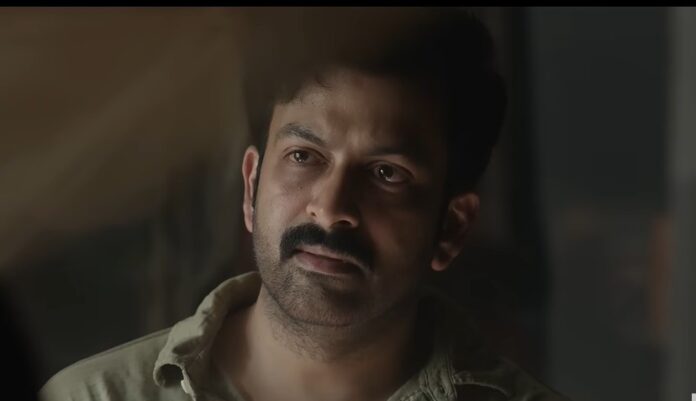
Thursday, July 9, 20206: Watching I, Nobody feels like standing inside a crowded room where everyone seems to know something you don’t. Conversations stop when the protagonist enters, eyes linger a little longer than they should, and every smile carries the possibility of betrayal. Nissam Basheer doesn’t begin with spectacle or loud declarations of danger. Instead, he creates unease from the ordinary, making familiar spaces feel quietly threatening. It is an approach that immediately pulls you in because the film understands that paranoia is often more effective when it grows slowly rather than arriving with a bang.
Rajeevan, played by Prithviraj Sukumaran, is the kind of man cinema rarely celebrates. He isn’t fearless, influential, or larger than life. He is a government employee whose biggest concern is providing for his family and getting through another routine day. That sense of normalcy becomes the film’s greatest strength because when his world begins to collapse, the audience feels the weight of what is at stake. One wrong place, one wrong moment, and Rajeevan finds himself trapped inside a web of crime, corruption, and institutional power that seems impossible to escape.
What makes the opening stretch in I, Nobody particularly engaging is how patiently the screenplay builds this transformation. Rather than rushing into twists, it spends time establishing Rajeevan’s everyday existence. His home, his workplace, and the relationships around him create a believable emotional foundation. When the danger finally arrives, it feels earned instead of manufactured.
I, Nobody Review: Intriguing, Not Involving
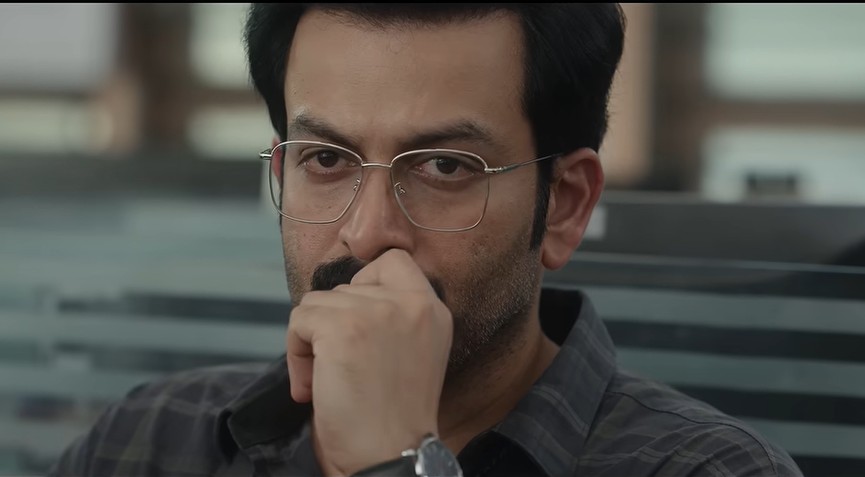
The film constantly explores the uncomfortable reality that truth alone is rarely enough. Once Rajeevan becomes entangled in forces much larger than himself, innocence begins to lose its value. Systems designed to protect people instead become instruments of intimidation, while authority carries an unsettling confidence that makes resistance appear almost pointless. This isn’t merely a thriller about solving a crime; it is about watching an ordinary citizen discover how fragile his place in society really is.
Prithviraj approaches Rajeevan with admirable restraint. There is no attempt to transform him into an action hero overnight or fill the character with cinematic swagger. Fear, confusion, hesitation, and vulnerability dominate his performance, making Rajeevan feel recognisably human. However, that same understated approach eventually works against the film. As the narrative raises the stakes, the emotional evolution remains surprisingly muted. The desperation of a man pushed to his limits rarely translates into a visible shift in personality. The journey asks for gradual transformation, but the performance remains rooted in the same emotional register for much of the runtime, making the character feel static during moments that demand greater urgency.
Parvathy, returning opposite Prithviraj after years, delivers one of the film’s most grounded performances. Meera isn’t written as someone who exists solely to support the hero’s journey. She reacts with quiet dignity, processing devastating revelations without exaggerated emotion. One particular confrontation captures the helplessness of a woman watching her family’s life unravel in front of her, and Parvathy elevates the scene through subtle expressions rather than dramatic dialogue. Yet the screenplay leaves her with little room to grow beyond those powerful early moments. Considering the anticipation surrounding the reunion of these two actors, the emotional distance maintained between their characters becomes one of the film’s biggest missed opportunities.
Visually, I, Nobody remains consistently impressive. Dinesh Purushothaman’s cinematography embraces shadows, confined spaces, and carefully composed frames that reinforce the film’s atmosphere of uncertainty. Even simple conversations carry visual tension because of the way characters are positioned within the frame. The camera frequently reminds viewers that Rajeevan is becoming increasingly isolated, trapped not only by circumstances but also by the invisible walls closing around him.
The sound design deserves equal appreciation. Silence is often used more effectively than background score, allowing footsteps, distant conversations, and ambient noise to amplify suspense. Instead of overwhelming scenes with loud musical cues, the film often trusts its environment to create anxiety. Jakes Bejoy’s score supports the narrative without becoming particularly memorable, while the action choreography remains grounded and believable, avoiding unnecessary stylistic excess.
The problem begins once the initial intrigue settles into a repetitive rhythm. The film repeatedly promises that a major revelation is waiting around the corner, but its progression becomes increasingly sluggish. Conversations stretch beyond necessity, investigative threads circle familiar ground, and scenes linger after making their point. At nearly two hours and forty minutes, the screenplay struggles to justify its length. Momentum, which is essential for a thriller built on uncertainty, gradually fades.
The central mystery also suffers because the eventual payoff doesn’t match the anticipation surrounding it. Every thriller asks its audience for patience, but patience must eventually be rewarded with either emotional impact or narrative surprise. Here, the reveal explains the puzzle without truly elevating it. Instead of recontextualising everything that came before, it simply concludes the story in a competent but underwhelming fashion.
Perhaps the film’s biggest disappointment lies in its treatment of the bank heist angle. On paper, it promises intricate planning, strategic execution, and nail-biting suspense. In practice, it functions more as a narrative device than a fully realised set piece. The mechanics behind the operation never become compelling enough to stand alongside the personal drama unfolding around Rajeevan. For a genre that thrives on precision and escalating tension, the heist surprisingly feels secondary.
The film also hints at larger observations about power, bureaucracy, and the invisible hierarchies that determine whose voices matter. These themes remain present throughout but rarely receive the narrative commitment needed to leave a lasting impression. Instead of digging deeper into these ideas, the screenplay often returns to procedural developments that lack the same emotional weight.
Despite its shortcomings, I, Nobody is far from an unsuccessful film. There is evident craftsmanship in its visual language, sincere performances from its lead cast, and an atmosphere that consistently keeps viewers invested. It simply never reaches the level of intensity its premise repeatedly promises. The ingredients for an exceptional conspiracy thriller are all present, but they never fully come together.
In the end, I, Nobody leaves behind a feeling that is perhaps more frustrating than disappointing. It isn’t the film it could have been, but it is interesting enough to remind you of that possibility throughout its runtime. Its strongest moments suggest a gripping psychological thriller hiding beneath the surface, yet the storytelling never fully uncovers it. For viewers willing to embrace its deliberate pace, there is enough to admire. For those expecting a tightly wound edge-of-the-seat thriller, the experience may feel like a journey that takes too long to arrive at a destination that doesn’t quite justify the wait.
Rating: 3.5/5