
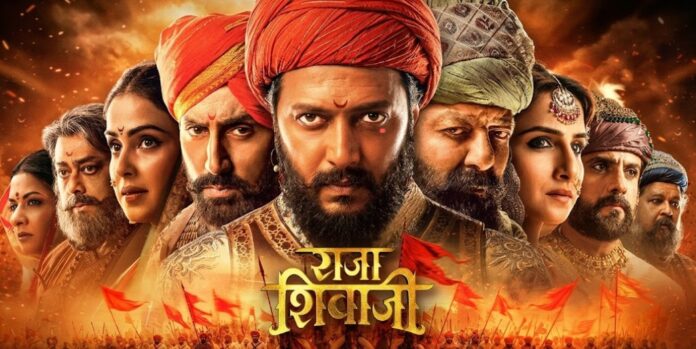
Saturday, April 2, 2026: There are films that tell you a story, and then there are films that try to build a legend. Raja Shivaji, directed by Riteish Deshmukh, clearly wants to do the latter. What works strongly for Raja Shivaji is its sincerity and visual ambition.
For years, cinema has celebrated Chhatrapati Shivaji Maharaj as a fearless warrior, sharp in strategy, unbeatable against larger armies, and always one step ahead of his enemies. This film tries to shift that image slightly, hinting at a more humane king. We see brief moments where Shivaji feels the pain of his people, like when a young Shivaji is shaken by a villager’s suffering, or when he delivers justice with swift, harsh action. These scenes aim to show a ruler who cared deeply about fairness and dignity.
But these moments pass too quickly. Instead of exploring his ideas of Swarajya, self-rule built on justice and empathy, Raja Shivaji leans heavily into hero worship. From the very beginning, Shivaji is presented as larger-than-life, almost divine. Even his birth is treated like a grand event, complete with dramatic visuals and a booming background score.
The first half spends a lot of time on his early years and his bond with his brother, played sincerely by Abhishek Bachchan. Their relationship adds some emotional weight, but it is often buried under long action scenes and loud dialogues. When the adult Shivaji finally appears, the film goes all-in on spectacle—slow-motion entries, stylised fights, and powerful music by Ajay-Atul. While these sequences look grand, they don’t always feel meaningful.
Raja Shivaji Celebrates Courage on a Majestic Scale
As an actor, Riteish Deshmukh is sincere, but his screen presence doesn’t fully match the towering image people associate with Shivaji. No amount of dramatic shots can fully bridge that gap.
Visually, the film is a treat in parts. Cinematographer Santosh Sivan brings depth with clever lighting and shadow work. To the film’s credit, it avoids turning history into a simplistic religious divide. Still, it falls into another trap, oversimplifying characters. Figures like Shah Jahan are reduced to caricatures, while Sanjay Dutt’s Afzal Khan becomes a classic over-the-top villain.
Raja Shivaji finally finds its rhythm in the much-awaited face-off between Shivaji and Afzal Khan. These sequences are engaging, showing Shivaji’s intelligence as much as his courage. The climax, involving the iconic Bagh Nakh moment, is gripping and feels earned.
Director Riteish Deshmukh approaches the story of Chhatrapati Shivaji Maharaj with clear respect, crafting several moments that reflect the king’s courage and emotional depth. The film looks grand, thanks to the striking cinematography by Santosh Sivan, where the use of light and shadow adds texture to battle scenes and royal settings.
Vidya Balan brings a quiet strength to her presence in Raja Shivaji, even though her screen time is limited. She doesn’t rely on heavy dialogue or dramatic outbursts; instead, she leans into subtle expressions and controlled emotions that leave a lasting impression in the moments she appears. There’s a natural dignity in the way she carries her role, adding a grounded texture to a film that often moves on a larger-than-life scale. Even in brief scenes, she manages to draw attention without forcing it, making her performance feel measured, composed, and memorable in its restraint.
The music by Ajay-Atul lifts key moments, giving them a larger-than-life feel that suits the epic tone. Performances, especially by Abhishek Bachchan and Sanjay Dutt, bring intensity and conviction, particularly in the film’s later portions. The climax, built around Shivaji’s encounter with Afzal Khan, stands out as a gripping blend of strategy, tension, and drama, showing the film at its most engaging and confident.
Yet, once the excitement settles, the film’s biggest weakness becomes clear. It celebrates Shivaji, but rarely explores him. His progressive ideas, his connection with common people, and the deeper meaning of Swarajya are touched upon but never fully realised.
By the end, Raja Shivaji feels like a respectful tribute, but also a missed opportunity. It builds a statue of the king, polished and powerful, but doesn’t quite bring the man behind it to life.