
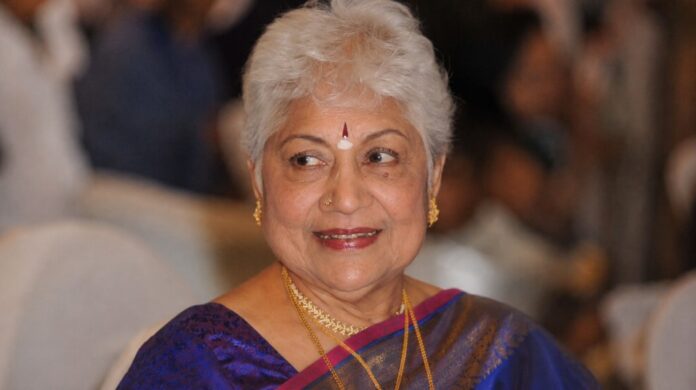
August 22, 2026: There are actors whose careers can be summed up by a handful of films. Sowcar Janaki’s cannot. Four hundred films tell one part of the story. Seven decades tell another. The real story lies somewhere between the two, in the extraordinary number of lives she inhabited, the generations of actors she worked alongside and the curious way she kept moving forward while the industry around her changed almost beyond recognition.
Janaki died in Chennai on Friday, August 21, at the age of 94, following age-related ailments. She breathed her last at 1.59 pm. Today, as her family prepares for her final rites at the Besant Nagar Crematorium, people from the film industry and the public are gathering to say goodbye. Her mortal remains were kept at her Chennai residence for people to pay their respects.
For an actress who spent so much of her life in front of cameras, her final appearance has a strange poignancy. There will be flowers, familiar faces, old colleagues, younger actors who knew her only in her later years, and fans who grew up watching her before they ever knew her name.
And perhaps that is the most fitting farewell for Sowcar Janaki. She belonged to several generations at once.
She never really belonged to just one era
When Janaki entered cinema with Shavukaru in 1950, Indian cinema was still finding its language. The studio system was strong, stars were being created, and actresses were often expected to fit neatly into a handful of familiar moulds.
Janaki quickly showed she could occupy several of them. Then she showed she could break them.
She could be the heroine, the wife, the daughter-in-law, the sharp-tongued woman in the next room, the sophisticated society figure, the comic presence, the mother and eventually the grandmother. She could make a supporting character feel like the most interesting person in the frame.
That quality became especially important as she moved away from conventional heroine roles. Her association with K Balachander was crucial. By the time she began working with the filmmaker, Sowcar Janaki had already established herself. Balachander gave her something more valuable than another opportunity to be a star: room to surprise.
Their association began in theatre with Mezhuguvarthi. Janaki joined his troupe and went on to appear in several of his films, including Neerkumizhi, Edhir Neechal, Kaviya Thalaivi and Iru Kodugal.
Those performances helped reveal the Sowcar Janaki that audiences had only partly seen.
She had timing. She had intelligence. She had an instinct for dialogue. Most importantly, she understood that a woman on screen could possess contradictions.
She could be funny and wounded. Proud and vulnerable. Loving and difficult. Conventional in one scene and startlingly modern in the next. That made her particularly valuable to filmmakers who wanted women to feel like people rather than plot devices.
She entered cinema for practical reasons
There is another part of the Janaki story worth remembering because it cuts through the mythology of the glamorous film career. She did not begin with the usual starry-eyed dream of becoming a film actress.
Her performing life began much earlier, through radio. As a young girl, she became associated with All India Radio in Madras and developed her craft before cinema came calling. Her early career included stage work as well.
In later interviews, Janaki spoke with striking practicality about her entry into films. Acting became a profession, a means of supporting her family, and then gradually became a lifelong artistic calling.
That distinction matters. She built a career at a time when women in cinema were frequently spoken about in terms of beauty, glamour and screen pairing. Janaki built hers around work. She worked. Then she worked some more.
And when the roles that had once made her a leading lady began disappearing, she simply changed the nature of the work. That may be her greatest lesson.
She grew older on screen — and kept working
Many actresses from her generation were gradually pushed away from the centre of cinema as they aged. Janaki went in the opposite direction. Age gave her different characters, and she embraced them.
She played mothers and grandmothers without treating those roles as retirement assignments. She appeared opposite actors who had once been children in the industry she had helped shape. She worked across Tamil, Telugu, Kannada and Malayalam cinema, with Hindi work also part of her long career. Her final Tamil film, Biskoth, marked her 400th film, while her last Telugu appearance came with Anni Manchi Sakunamule in 2023.
There is something quietly remarkable about that longevity. She did not spend her later years trying to recreate the young Sowcar Janaki. She allowed audiences to meet the older one.
That is why her later performances carry their own warmth. The face had changed. The voice had acquired another texture. The experience of decades sat behind the eyes.
She had lived enough life to play age honestly.
Look beyond the famous films
For younger viewers discovering her today, the temptation will be to begin with the greatest-hits list.
Bama Vijayam.
Iru Kodugal.
Paarthaal Pasi Theerum.
Paarthiban Kanavu.
Paava Mannippu.
Edhir Neechal.
There is plenty there.
Yet the more interesting journey lies in watching how the actress changes between them.
Watch her with Sivaji Ganesan. Watch her with MGR. Watch her with NTR and A Nageswara Rao. Watch her opposite Rajkumar. Watch her later work with Kamal Haasan, Rajinikanth and Mammootty.
The generation changes. The stars change. The filmmaking changes.
Janaki keeps adjusting.
Kamal Haasan’s farewell on Friday captured something of that unusual relationship. He remembered working with her across decades, with her playing his mother while he played her son, and described her as an irreplaceable acting artist of South Indian cinema. That word — irreplaceable — carries weight.
Indian cinema has plenty of stars. It has fewer actors whose presence can immediately tell you something about the period, the society and the people being portrayed. Janaki was one of those actors.
The name came from a film. The legacy came from her
The curious thing about Sowcar Janaki is that the name itself was given to her by cinema.
She was born Sankaramanchi Janaki. Shavukaru, her first film, brought her the name Sowcar, which stayed with her for the rest of her life. Millions eventually knew the screen name more intimately than the name she was born with. That happens to stars.
What makes Janaki unusual is that the name survived long after the era that created it had disappeared. She was still Sowcar Janaki when the industry had moved from studios to outdoor locations, from black-and-white to colour, from single-screen theatres to multiplexes, and finally into the streaming age.
She had seen almost everything Indian cinema could become. She kept finding a place inside it.
Today, the silence will feel different
The tributes that poured in after her death came from across the political and film worlds. Tamil Nadu Chief Minister Vijay called her passing an irreplaceable loss. Chiranjeevi remembered the journey that began with Shavukaru. N Balakrishna recalled that she had been the first female lead opposite his father N T Rama Rao. Leaders in Andhra Pradesh and Telangana also remembered her contribution to Telugu cinema.
Those tributes tell us where she stood in the industry. The films tell us why. Yet perhaps the simplest way to understand Sowcar Janaki is this:
She stayed when the heroes changed, genres evolved, audiences shifted, and the very idea of a leading actress was redefined. She stayed long enough to become something more enduring than a leading lady. She became part of the furniture of Indian cinema — familiar, dependable, occasionally mischievous, often formidable, always recognisable.
For audiences who knew her work, her absence will feel personal. For those who know only the name, this is the moment to go looking. Start anywhere.
Pick an old Sivaji Ganesan film. Find a Balachander classic. Watch her comic work. Look at the later mother and grandmother roles. Listen to her voice. Watch the eyes.
The point is less about finding the “best” Sowcar Janaki performance. There were too many of them. The point is to discover an actress who spent 73 years refusing to be only one thing. That may be the finest tribute of all. Sowcar Janaki has taken her final bow. The characters have stayed behind.
And they are going to keep introducing her to new audiences for a very long time.